
What happens when life or work doesn’t unfold according to plan? In her latest article, TallSky Executive Coach and HR Associate Meredith Campbell-Jess explores the often-overlooked space between expectation and reality, and how those moments can shape resilience, perspective, and growth in unexpected ways. You can also follow more of Meredith’s fabulous writing on her Substack.
There’s something about an unplanned road trip that quietly rearranges your brain.
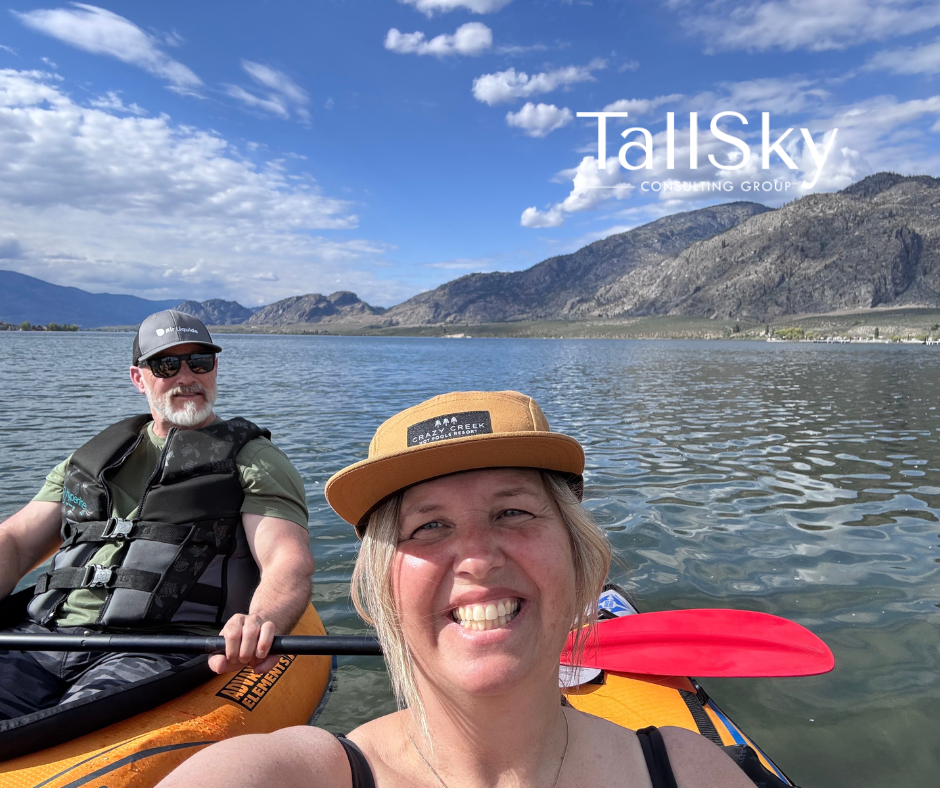
Last week, my husband and I decided, with very little discussion and even less planning, to drive from our little corner of Alberta down to Osoyoos. No big agenda. No colour-coded itinerary. Just a vague idea that we’d bike, maybe kayak, and see what happened.
And it turns out, that was the point.
The Myth of the Perfect Plan
In my world, planning is a love language. It’s also a professional reflex. I spend a lot of time helping teams get clear, aligned, structured, and moving in the same direction. It matters. A lot.
But somewhere between loading the bikes and realizing we hadn’t even booked dinner plans, I felt this subtle shift: nothing was optimized. And nothing needed to be.
We biked when we felt like it. We kayaked when the water looked too good to ignore. We stopped for coffee without checking reviews. It was inefficient. It was imperfect.
It was also… kind of ideal.
A Detour I Would Have Missed
Somewhere just outside Revelstoke, we pulled off for what was supposed to be a quick stretch break and ended up at Crazy Creek Hot Pools.
If you’ve never been, it’s tucked into the forest with tall trees overhead, birds echoing through the quiet, and small breaks in the landscape where the river comes into view, steady and grounding, with hot pools that feel like you’ve stumbled into something you weren’t quite meant to find.
We stayed longer than planned…and booked a cabin for the night. Of course we did.
There’s a particular kind of quiet that shows up in places like that. Not silence, but stillness. The kind that makes you realize how loud your own head has been.
And it hit me, pretty plainly: I would have driven right past it if this trip had been tightly planned.
What Happens When You Stop Managing Everything
There’s a particular kind of mental load that comes from constantly holding things together. Decisions, logistics, outcomes, expectations. You don’t always notice it until you put it down.
Out there, in warm water with giant mountain in the background, I wasn’t managing anything. Not a team. Not a timeline. Not even the day.
Just… being there.
And here’s what struck me: when you remove the pressure to control the experience, you create space to actually have one.
The Leadership Parallel (Because Of Course There Is One)
I couldn’t help it. This is where my brain goes.
We talk a lot about clarity and structure in teams, and for good reason. But there’s another side that doesn’t get as much airtime: over-structuring.
When everything is tightly managed, tightly scheduled, tightly controlled, you can unintentionally squeeze out the very things you’re trying to create:
- creativity
- ownership
- curiosity
- real engagement
Sometimes the best thing a leader can do is step back just enough.
Not disappear. Not abdicate. Just… loosen the grip.
Let people find their own rhythm. Let conversations unfold. Let a bit of “inefficiency” in, because that’s often where the good stuff lives.
A Small Reframe
I didn’t come back from this trip with a grand epiphany. No dramatic life pivot. No “I’ve quit structure forever” moment (let’s be realistic).
But I did come back with a new question:
Where might I be over-planning something that could actually benefit from a little more space?
Not less intention. Just less control.
Because sometimes, the best days, the best ideas, and even the best team moments aren’t the ones you engineered perfectly.
They’re the ones you left just enough room for.